Built Up Roof Systems
Miami, FL · Roof Systems
Miami-Dade's pre-1992 commercial building stock carries the largest concentration of aging built-up roofing in the Southeast United States. Hurricane Andrew stripped the perimeter flashings from thousands of these roofs in 1992. What survived Andrew and has not been replaced since is now past its designed service life by a decade or more.
Built-up roofing — alternating plies of bitumen and reinforcing felt mopped together over a substrate — was the dominant commercial roofing system in Miami-Dade from the post-war building boom through the early 1990s. The Hialeah industrial belt, Downtown Miami's older commercial buildings, the pre-, and institutional buildings across the county were built with BUR systems that were designed for a code environment that predated both the FBC HVHZ and the Miami-Dade NOA system.
Hurricane Andrew's destruction of Miami-Dade's pre-1992 roof stock was not uniformly complete — some BUR systems survived. The ones that survived did so in part because they were in sheltered exposure positions, in part because they had been recently re-gravel surfaced and had fresh mop coats on the cap, and in part because the structural parapets they terminated against happened to resist uplift loading that stripped neighboring roofs. Survivor bias has kept some of these aging BUR systems in service long past what their condition warrants.
Our work on built-up roofs in Miami is primarily diagnostic: moisture survey, core sampling, deck condition assessment, and honest capital planning advice. We install new built-up roofing systems in Miami-Dade where the application calls for it — the multi-ply redundancy and field-blended nature of BUR have specific advantages for certain concrete deck buildings and certain budget profiles. But the primary value we provide on BUR work is the condition assessment that tells the building owner what they actually have and when replacement becomes unavoidable.
Assessing Miami's Aging BUR Inventory
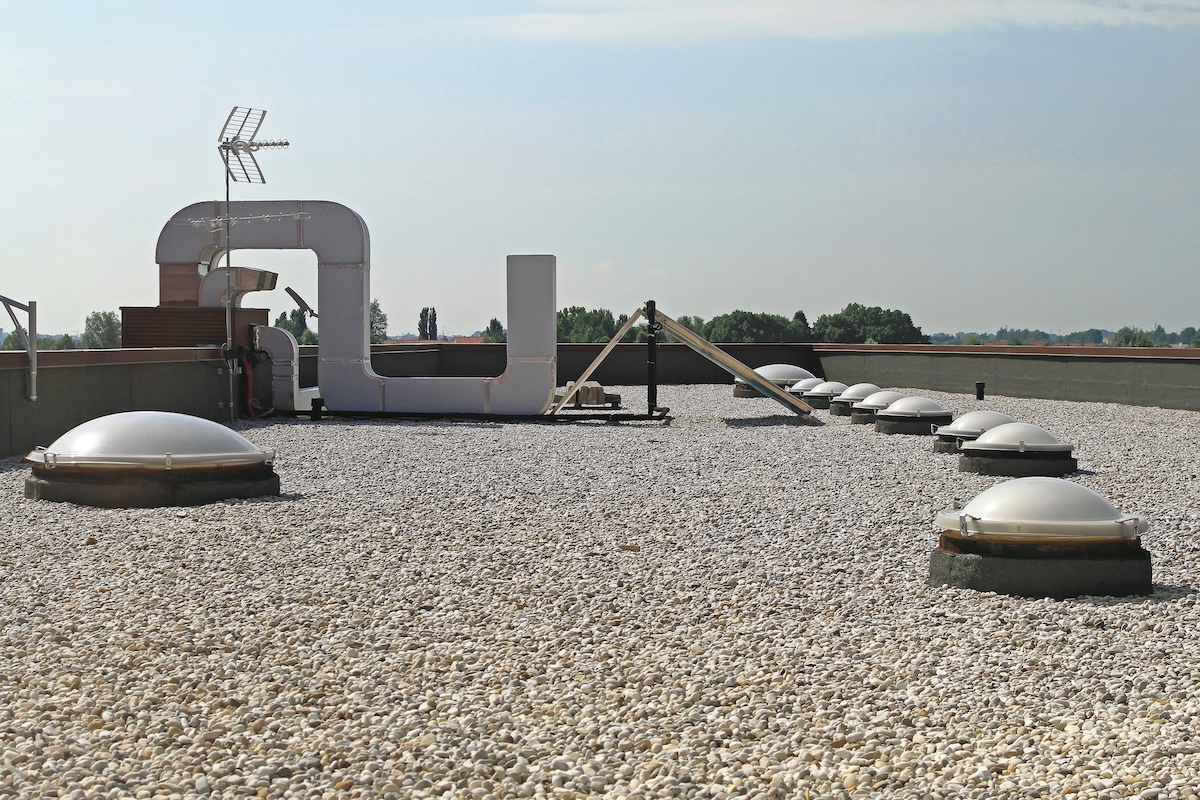
Miami-Dade BUR roofs from the 1960s through the 1980s are now 40 to 60 years old. The bitumen plies have undergone decades of Miami UV exposure, thermal cycling, and in many cases at least one hurricane event. The gravel surface that was supposed to protect the bitumen from UV has redistributed to drain sumps and low points, leaving the cap sheet exposed. Blisters — pockets of moisture-laden air between plies — are common on BUR systems of this vintage in Miami's humidity.
Moisture survey on aging BUR requires nuclear moisture scanning or infrared thermography in addition to core sampling. Miami's wet season produces moisture infiltration events that can be weeks or months old by the time they appear as interior ceiling staining — the saturation has spread horizontally through the insulation well beyond the visible interior leak location. Nuclear scanning maps the saturated area and allows us to quantify how much of the insulation is wet before recommending recover versus replace.
Deck condition under aging BUR in Miami is the variable that most often forces scope decisions. Pre-1992 buildings in coastal Miami environments have metal decks that have been exposed to high humidity and periodic water infiltration for 30 to 60 years. Deck section loss from corrosion is common on roofs that have had chronic water intrusion. We pull deck inspection ports under all wet core locations and at any visible deck deflection before finalizing replacement scope.
New Built-Up Roofing in the HVHZ
New BUR installation in Miami-Dade is less common than it was 30 years ago, but there are applications where it remains the right specification. Multi-ply BUR provides waterproofing redundancy and substrate tolerance that single-ply systems cannot match on certain older concrete deck buildings. Smooth-surface BUR with a reflective aluminum coating is a legitimate specification for buildings where the owner wants a long-term low-maintenance system and the structural deck supports the assembly weight.
Miami-Dade NOA approvals exist for current BUR assemblies from major manufacturers, including the specific felts, bitumen formulations, and surfacing materials as a complete system. The HVHZ base ply attachment requirement applies to BUR just as it applies to single-ply — the mechanically fastened base ply must be designed to the three-zone ASCE 7 uplift pressures for the specific building. We do not install BUR systems without a current Miami-Dade NOA approval for the complete assembly.
Sea-level rise is a BUR-specific consideration for Miami buildings near Biscayne Bay, the Miami River, and low-elevation Miami Beach properties. Buildings with finished floor elevations below 3 feet NAVD88 are experiencing king-tide flooding that delivers salt water to the building perimeter at grade. Salt water wicks through wall assemblies and reaches the roof-to-parapet joint from below. BUR parapet flashing terminations on these buildings show accelerated bitumen oxidation at the base of the parapet as a result of salt water capillary action — a failure mode that is not visible from the roof surface.
BUR Repair Versus Replacement in Miami
Spot repair of isolated BUR failures is appropriate where the failure is localized to a specific drain, penetration, or flashing and the surrounding membrane is in structurally sound condition. We use compatible SBS-modified bitumen patches for BUR cap sheet repairs — straight bitumen patch materials applied to oxidized BUR surfaces do not bond reliably in Miami's conditions. Repairs are photographed and keyed to a roof zone diagram at closeout.
The replacement trigger for aging BUR in Miami is not a single threshold — it is the combination of wet insulation percentage (above 25% wet), deck condition (corrosion or section loss), and FBC HVHZ compliance status (most pre-1992 BUR does not have a current NOA and does not Buildings that fail two of the three criteria are candidates for full replacement in the next capital cycle. Buildings that fail all three are candidates for replacement now.
Frequently asked questions
Can a pre-1992 built-up roof pass Miami-Dade inspection if I need to sell the building?
A pre-1992 BUR that has not been replaced or substantially upgraded does not It may pass a visual inspection for current leak condition, but it will not pass a code-compliance assessment for HVHZ attachment design. Property transactions involving commercial buildings with pre-1992 roofing often require a roofing condition report — we provide those reports with specific language about HVHZ compliance status and estimated remaining service life.
Is my BUR roof covered by any manufacturer warranty?
Original manufacturer warranties on pre-1992 BUR systems have long since expired. Any active warranty would need to have been renewed or transferred through a documented maintenance program, which is uncommon on aging BUR inventory. If the building has been sold since the original installation, the warranty documentation may not have transferred. We assess what documentation exists and advise on the warranty-recovery path — which on most aging BUR is a full replacement with a new warranty.
What does a BUR moisture survey cost, and what does it tell me?
Infrared thermography or nuclear scanning of a BUR roof typically costs $500 to $1,500 for a standard commercial building depending on roof area and access complexity. The survey maps wet insulation areas to a roof plan, allowing you to see what percentage of the insulation is saturated and where. This data is the basis for the recover-versus-replace recommendation and for any insurance documentation of water intrusion scope. We include the moisture map in our written condition report.
Can you install a new built-up roof over my existing BUR?
Florida Building Code allows one recover layer over an existing roof assembly. If moisture cores confirm the existing BUR insulation is dry and the deck is structurally sound, a new BUR or single-ply assembly can recover the existing system. The cover board requirement for the recover assembly depends on the new system's NOA. If deck corrosion is found under wet areas, the scope converts to full replacement at those zones regardless of the recover decision elsewhere.
Get a BUR condition assessment and capital-planning scope.
Our project managers will walk the roof, pull cores at representative locations, scan for moisture, and give you a written report covering current condition, HVHZ compliance status, and replacement timeline.
Explore More
- TPO Roof Systems
- EPDM Roof Systems
- PVC Roof Systems
- Modified Bitumen Systems
- Standing Seam Metal Systems
- Hurricane Wind Uplift Roofing
- Single Ply Roofing
- Office Building Roofing