Fast Food QSR Roofing
Miami, FL · Property Types
Miami's commercial market spans Brickell, Wynwood, the Design District, Miami Airport industrial zone, the I-95 and Palmetto Expressway corridor, and the rapidly expanding Doral and Hialeah logistics and industrial hub. Quick-service and fast-food restaurant properties in this market represent a high-density roofing category — small-footprint buildings with 24-hour operations, grease-exhaust penetration density exceeding standard retail, and franchisor brand compliance requirements that govern product selection and documentation at every brand-owned location.
Coral Gables Miracle Mile restaurants operate under Coral Gables' noise and construction standards, which are more restrictive than unincorporated Miami-Dade.
Quick-service restaurant properties are among the most liquid assets in commercial real estate — they trade frequently, they're valued on their net lease income, and their capital maintenance history directly affects their valuation multiple. A QSR property in Miami with a current, warranted roof and documented maintenance records is a cleaner asset at sale or refinancing than one with deferred maintenance and no inspection history. The property manager or franchisee who treats QSR roofing as a capital investment decision — not just an operating expense — captures that value at transaction time.
Net lease QSR properties in Miami typically structure roofing responsibility under the triple net (NNN) lease terms — the tenant (the franchisee or operating company) is responsible for all maintenance and capital improvements. This means the tenant — not the landlord — is both paying for the roof and bearing the business risk if the roof fails. The alignment of maintenance responsibility and operational risk makes proactive roofing investment the clear economic choice for NNN tenants: a roof failure is both a capital expense and a business interruption event on the same balance sheet.
Portfolio management for multi-unit QSR operators in Miami is where the most significant ROI opportunities exist in restaurant roofing. An operator with 15-25 locations can develop a portfolio-level condition assessment, prioritize locations by condition and risk, and implement a rolling re-roofing program that keeps every location under warranty while spreading capital spending across budget cycles. The alternative — reactive emergency re-roofing at individual locations as failures occur — is the most expensive and most disruptive way to manage a portfolio.
QSR & Fast-Food Roofing — ROI Questions
A QSR property in Miami with deferred roofing maintenance — evidenced by visible water staining, active leaks, or an expired warranty — typically receives a buyer's credit demand in the range of 1.5-2.5x the estimated re-roofing cost, because the buyer is pricing in the disruption and uncertainty of managing the project post-acquisition. A property with a current warranty and recent inspection records provides documentation that eliminates this buyer credit discussion. The cost of a proactive re-roof before sale typically returns 150-200% of its cost in eliminated buyer credit negotiations.
A significant water intrusion event at a QSR location in Miami — water over food prep equipment, kitchen shutdown required, health department notification — typically costs $15,000-40,000 in direct emergency repair costs, plus the revenue lost during the health department mandated closure period (typically 1-3 days), plus the cost of health department re-inspection and any required remediation documentation. For a high-volume QSR location generating $2,000-4,000 per day in sales, a 2-day closure is a $5,000-8,000 revenue event. The total cost of a water damage incident frequently exceeds the cost of the timely re-roofing that would have prevented it.
We start with a condition assessment across all locations in the portfolio — a 2-3 hour inspection per location that produces a condition score, estimated remaining service life, and priority ranking. From the assessment, we develop a 3-5 year capital program that schedules each location's re-roofing in priority order, with annual cost projections that fit within the portfolio's capital budget. Locations with more than 5 years of remaining service life go into a maintenance program; locations within 5 years go into the replacement queue. The plan is updated annually with each inspection cycle.
QSR buildings are high-energy-density occupancies — they run HVAC systems continuously for cooking exhaust management and customer comfort, and the roof's thermal performance directly affects the HVAC load. A re-roofing project that upgrades insulation from R-15 to R-25 (a typical improvement in a re-roof) reduces the annual HVAC energy load for a typical QSR location by 8-15% depending on the climate. For a location spending $40,000-60,000 annually on energy, that's a $3,000-9,000 annual savings that contributes to payback on the insulation upgrade cost.
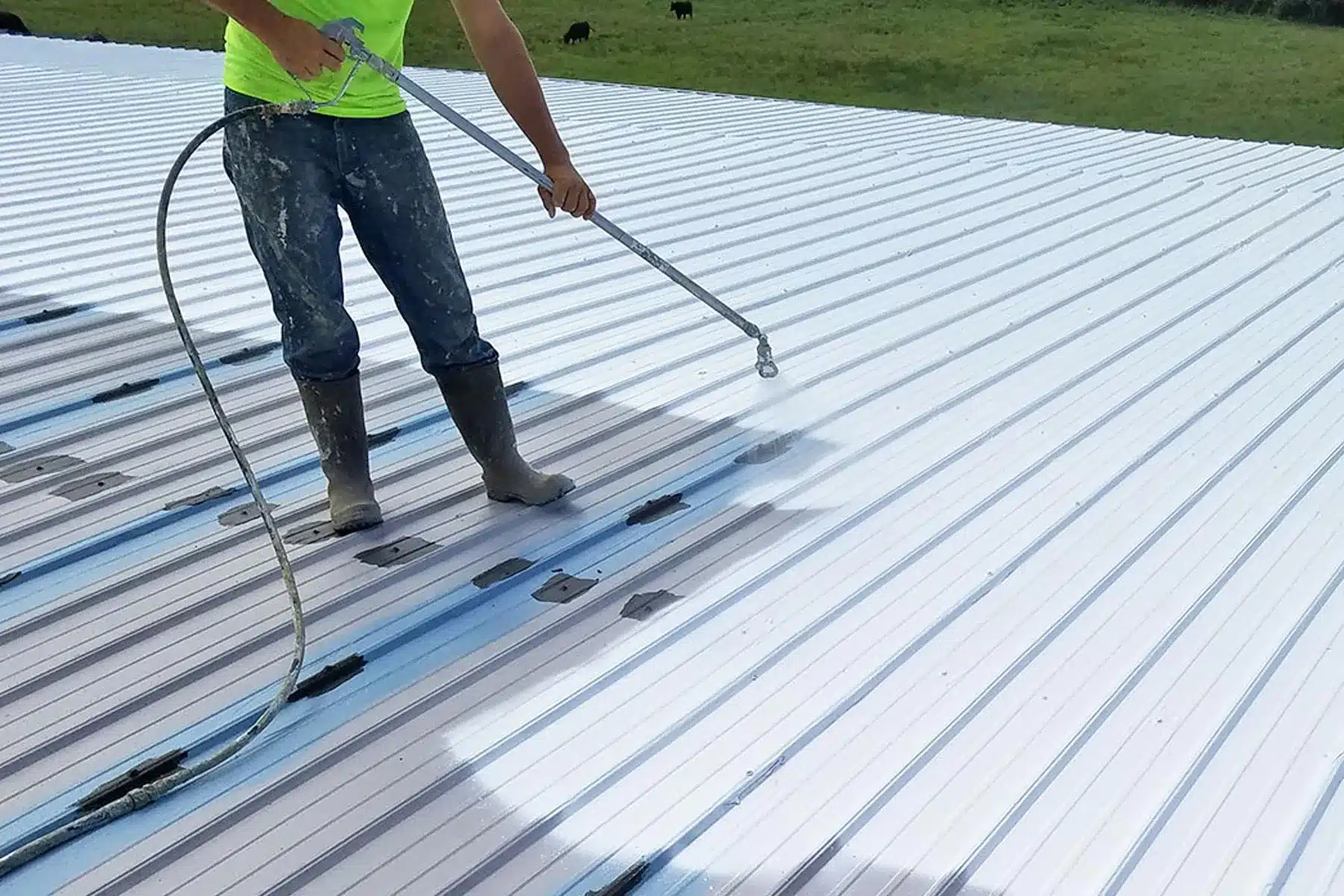
Coatings restoration — silicone or acrylic coating over an existing membrane — is appropriate for QSR roofs where the existing membrane is in the last 5-8 years of its service life with no moisture infiltration, sound seams, and no cooking exhaust chemical degradation at penetration zones. For QSR roofs with grease-exposed membrane sections near exhaust fans, coating over a chemically degraded membrane extends the appearance of the roof without restoring its performance. We conduct a membrane condition assessment before recommending coatings — on QSR roofs, the cooking exhaust exposure zones are frequently more degraded than they appear from a surface inspection.
Explore More
- Data Center Roofing
- Mixed Use Development Roofing
- Airport Terminal Roofing
- Veterinary Clinic Roofing
- Multifamily Roofing
- Hotel Roofing
- Hurricane Damage Roof Repair Service
- Silicone Roof Coating